Five services. Done properly.
We work on two-post, four-post, scissor and mobile column vehicle lifts — the lift types you'll find in nearly every UK workshop. The five services below cover everything most customers ever ask us to do. If your job doesn't quite fit, ring us — chances are we've done something like it.
Vehicle lift installation
From a single home garage install to a multi-bay workshop fit-out — to manufacturer spec and BS 7980:2024.
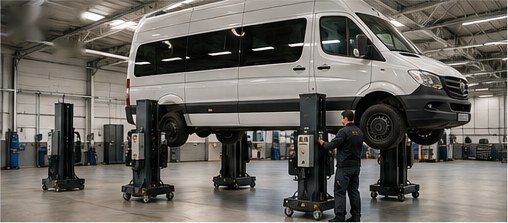
Most installation jobs follow the same shape — whether it's a 2-post in a private garage or a row of 4-posts in a commercial bodyshop. We start with a site survey to look at the floor, the available height, the power supply and the access. We then quote the work in writing, including the lift positioning, the anchoring method, and the commissioning steps.
On the day, we work to manufacturer specification and to the guidance set out in BS 7980:2024 — the British Standard for vehicle lift installation, maintenance, thorough examination and safe use. The lift is anchored, levelled, plumbed, wired, function-tested and load-tested before we leave.
You get a full handover, a service-and-safety walk-through, and the manufacturer's documentation pack in good order — ready for its first LOLER thorough examination.
What's included
- Pre-install site survey (floor, slab, height, electrical supply, access)
- Risk assessments & method statements (RAMS) for commercial sites
- Lift positioning, anchoring, levelling & alignment to spec
- Hydraulic and electrical first-fix and connection
- Function testing & load testing before sign-off
- Customer handover and operator walk-through
- Manufacturer documentation pack handed over for your records
- Coordination with your electrician or builder where required
Planned servicing
Six-monthly and annual schedules to keep your lift safe, compliant, and earning its keep.
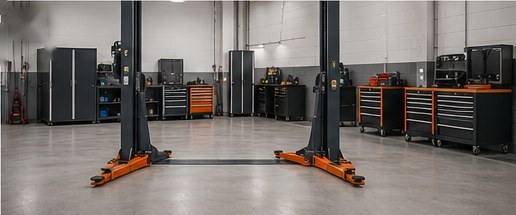
Vehicle lifts work hard and need regular servicing to stay safe — and to pass their statutory thorough examination. Industry guidance under BS 7980:2024 recommends a six-monthly service interval for vehicle lifts, because of the risk to anyone working underneath a raised vehicle.
We run two standard schedules: an annual service for lower-use private installs, and a six-monthly service for commercial workshop lifts that earn their living every day. Each visit ends with a written service report you can keep on file for compliance, insurance and resale.
What's included on every visit
- Hydraulic system pressure check, oil level & leak inspection
- Mechanical wear inspection — pivots, pins, bushes, slides, runners
- Cable, chain, sheave & pulley inspection where fitted
- Electrical & control circuit checks
- Safety lock, latch and pawl testing
- Lubrication of all serviceable points
- Operational test through full cycle, with and without load
- Written service report handed over before we leave
Breakdowns & repairs
A real engineer on the phone. Real diagnostics on site. The fix done once, not three times.
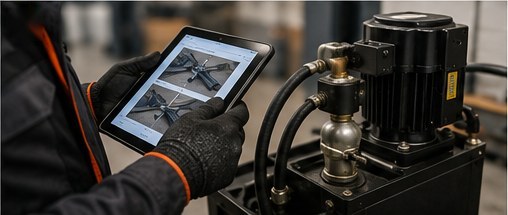
A lift that won't lift means a workshop standing still and money going out the door. Ring us, describe what's happening, and you'll get a real engineer on the phone — not a call handler reading from a script. Most faults can be narrowed down to one of a couple of likely causes over the phone, so when we arrive we've already worked out what we're probably looking at.
If the fault is straightforward and we have the part on the van, we'll fix it on the visit. If it needs parts ordered in, we'll quote the repair in writing — labour and parts broken out — before any work starts.
Typical repair work
- Hydraulic ram & cylinder repairs, seal replacement
- Hose, fitting & pipework replacement
- Cable, chain & sheave replacement
- Control board & PCB faults
- Limit switch, sensor & proximity switch replacement
- Locking pawl & safety latch repairs
- Power pack & motor diagnostics
- Genuine & pattern parts sourcing to suit budget
LOLER preparation & remedial work
We get your lift ready to pass. The thorough examination itself is done by an independent inspector.
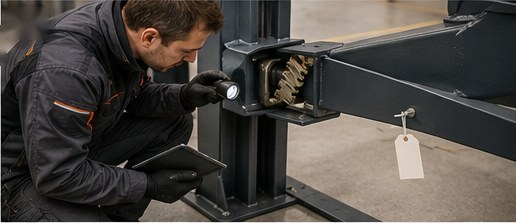
The Lifting Operations and Lifting Equipment Regulations 1998 (LOLER) require vehicle lifts to undergo a thorough examination by a competent person every six months. This applies to two-post, four-post, scissor lifts and any mobile/trolley jack used to lift vehicles.
There's an important rule the HSE is firm on: the same person who carries out routine maintenance on a lift cannot also do its statutory thorough examination. That's because they'd be assessing their own work. Some companies blur this line — we don't.
Here's what we actually do:
Our role around your LOLER
- Pre-examination service & visual inspection
- Identifying likely defects before the inspector arrives
- Remedial repairs to address known issues
- Coordination with your inspector (or our partner inspector)
- Post-examination remedial work to clear any defects
- Compliance records aligned with your insurance & HSE requirements
Lift relocation & decommissioning
Moving premises or reorganising the workshop? Done badly, a relocated lift fails its next LOLER. We don't do it badly.
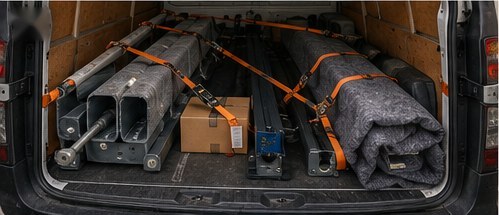
Lifts get relocated more often than people expect — workshops expand, businesses move, or a private customer sells a property and wants to take their 4-post with them. Done properly, a relocated lift performs the same on day one in its new home as it did the day before it was moved. Done badly, you end up with alignment issues, anchor problems, or a lift that fails its next LOLER.
What's covered
- Survey of both the old and new locations
- Slab and floor suitability check at the new site
- Safe decommissioning, including hydraulic oil drain
- Transport & short-term storage between sites if needed
- Re-installation to manufacturer specification
- Recommissioning, function testing and load testing
- Pre-LOLER preparation for the next thorough examination
- Operator re-training where needed
Every lift type you'll find in a UK workshop.
Two-post, four-post, scissor and mobile column lifts share more in common than they differ. The hydraulics, the safety locks, the wear points — fundamentally the same engineering principles, with small variations between manufacturers. An experienced engineer is competent across all of them.
-
01
Two-post lifts Hydraulic, with chain or wire rope synchronisation. The workhorse of MOT bays and bodyshops.
-
02
Four-post lifts Hydraulic, including alignment-rated lifts. Common in dealerships, fleet workshops and home garages used for storage.
-
03
Scissor lifts Low-rise, mid-rise and full-rise — including MOT-style scissor lifts. Suited to bodyshops where access matters.
-
04
Mobile column lifts Hydraulic and electromechanical, single-column and matched sets. Used for HGVs, buses and heavy fleet vehicles.
-
05
In-ground lifts Single and twin-ram in-ground lifts. Subject to site conditions and access — survey-led.
-
06
Not sure what you've got? Send us a couple of photos including the manufacturer plate and we'll tell you what it is and what it needs.
By the book.
The three pieces of UK guidance and legislation that govern vehicle lift work. Every job we do is aligned to them.
You don't need to remember the regulation numbers. We do. What it means in practice:
Every install we do follows BS 7980:2024 for site preparation, anchoring method, load testing and handover. Every service interval we recommend is based on the same standard. Every lift we work on gets its thorough examination done independently — by a separate, qualified competent person — not by us, because the regulations are clear that the same person can't both maintain and inspect.
When we hand a lift back to you, it's ready for its next LOLER thorough examination and its compliance paperwork is in order.
Tell us the lift type, the postcode, and what needs doing.
Written quote back within one working day. If we don't think we're the right people for the job, we'll say so.